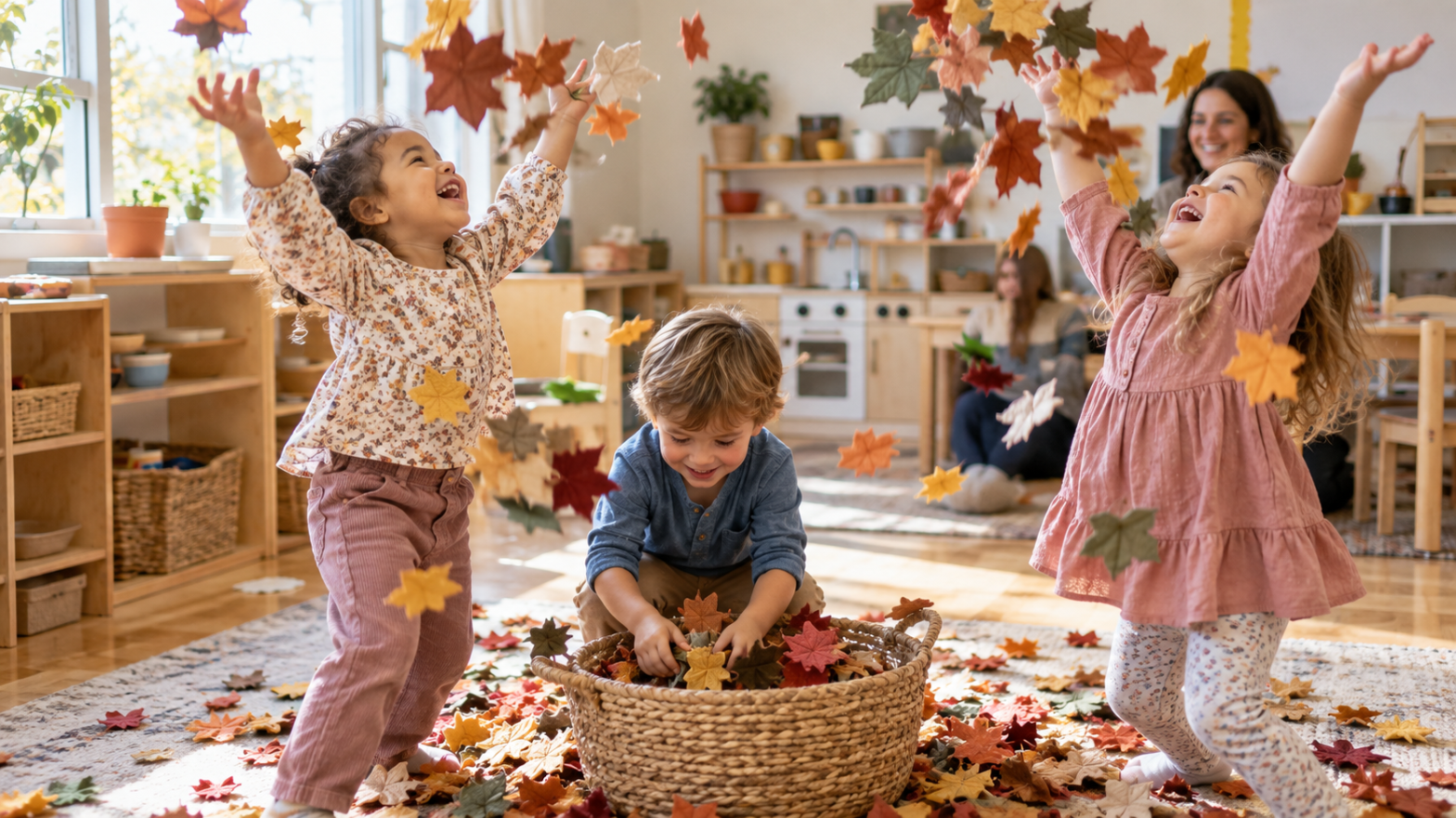
I once put a basket of loose fake leaves into dramatic play.
The children could have carefully raked them. They could have sorted the colors, filled baskets, or carried them around the pretend kitchen.
Instead, they grabbed giant handfuls and threw them into the air.
The leaves went everywhere.
They covered the rug, the kitchen, the shelves, and the children. The kids laughed, scooped them up, and threw them again.
And I let them.
They were not hurting anyone. They were not destroying the materials. They were completely absorbed in their play.
So why would I stop them just because the leaves were no longer where I had imagined they would be?
Sometimes the best thing a teacher can do is just let them
Let them throw the loose leaves into the air.
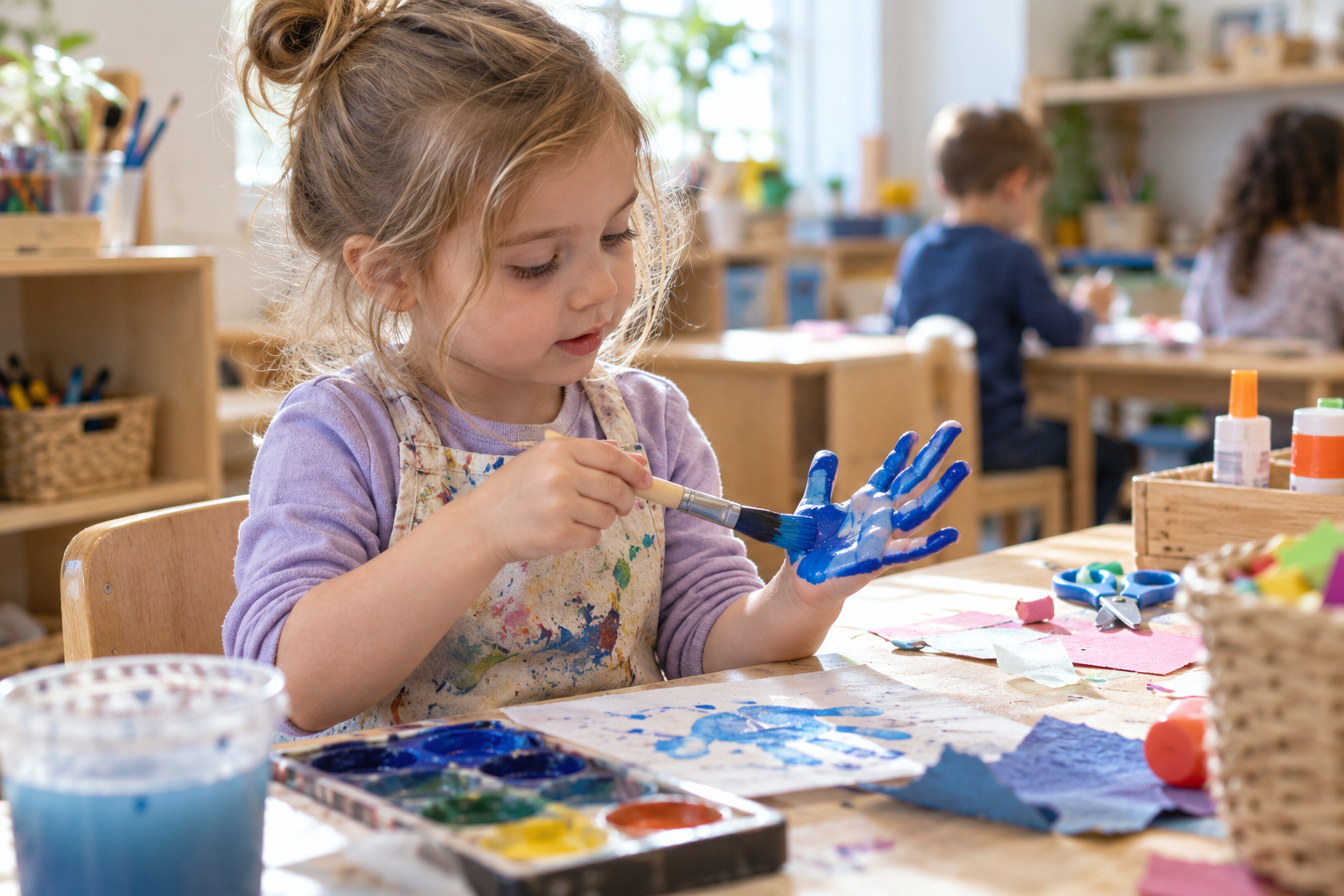
Let them paint their hands at the free-play art center.
Let them put their arms into the shaving cream and “swim” through it.
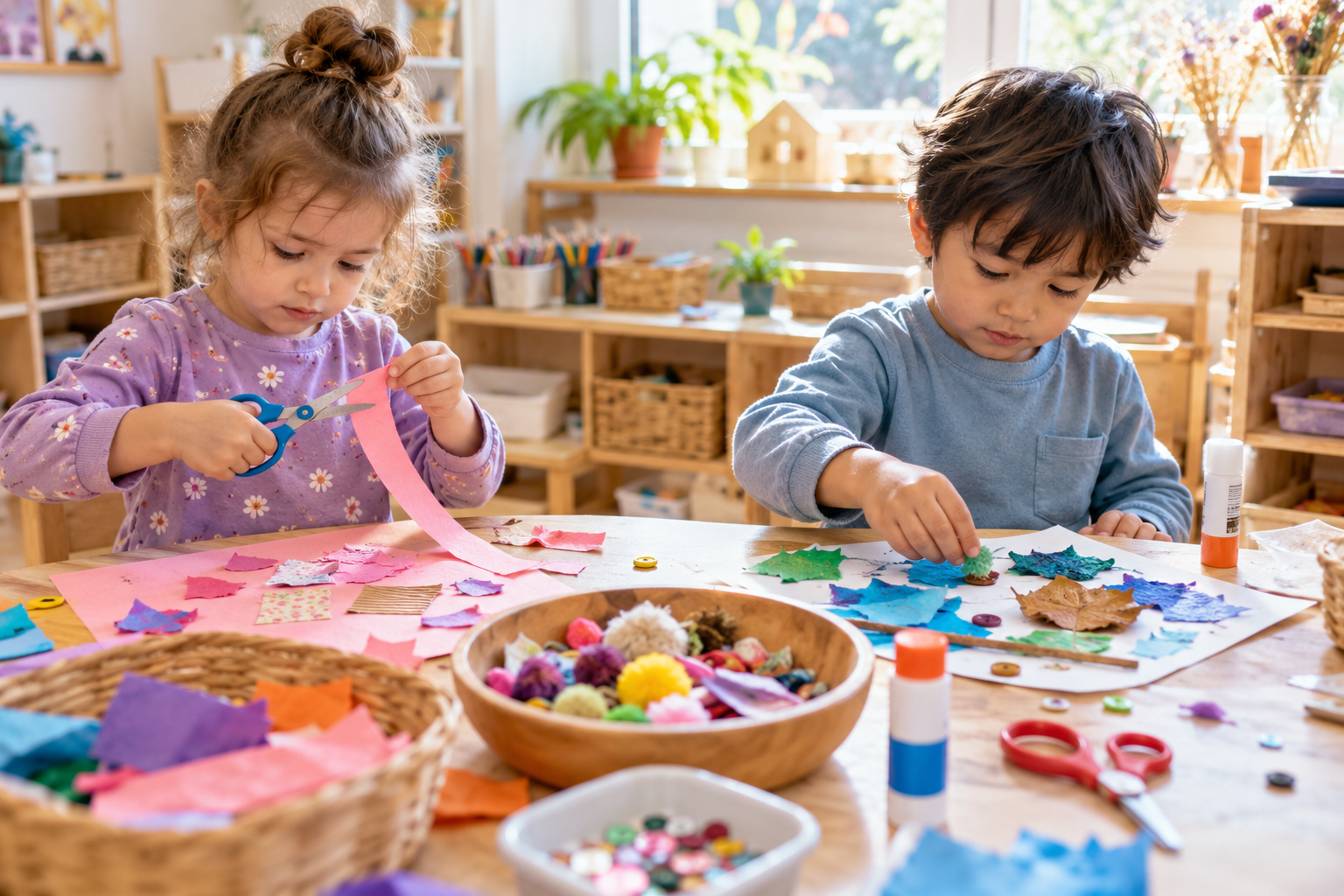
Let them cut the paper into a hundred tiny pieces and glue three of those pieces to the very corner of the page.
Let them make something that looks nothing like the example you had in your head.
Not every unexpected choice is a problem
When a child uses a material differently than I expected, I try to pause before I redirect them.
Is it unsafe?
Are they damaging something?
Are they preventing someone else from playing?
If the answer is no, the real problem may simply be that their play does not look the way I pictured it.
A child painting their own hand may look like they are “misusing” the paint. But they may be exploring how the brush feels against their skin, watching the color cover their palm, or planning to make a handprint without an adult ever suggesting it.
The paint is washable. Their hands can be cleaned. The table can be wiped.
I do not need to stop a meaningful experience to protect the room from something I already know how to wash.
I had to unlearn the perfect preschool project
I used to want the projects to look right.
If we made a tiger, the tiger needed all of its stripes. The pieces belonged in certain places, and I wanted the finished project to look like the animal we were supposedly making.
But if every tiger looks the same, whose creativity are we celebrating?
Now, a child might cut one stripe, glue it sideways, decide the tiger is finished, and move on. Another child might cover the entire page. Someone else may ignore the tiger idea and make something completely different with the same materials.
That is not the activity going wrong. That is the child making a decision.
That same belief is why I created Play Beyond Purpose: simple invitations that begin with an ordinary material and leave room for the children to decide what happens next.
Freedom does not mean anything goes
“Just let them” does not mean I ignore safety, allow children to hurt one another, or let one child ruin the experience for everyone else.
There are still boundaries.
Paint stays away from faces and mouths. Scissors are used safely. Materials are not thrown when they could hurt someone. A child cannot dump every item simply to keep the other children from using it.
The boundary protects the people and the materials. It does not protect my original idea.
That difference matters.
Teach cleanup instead of removing the experience
Messy play creates cleanup. There is no pretending otherwise.
The fake leaves still have to go back into the basket. Paintbrushes need to be washed. Paper scraps have to be swept. Shaving cream has to be wiped from the floor before someone slips.
But cleanup is also part of learning how to use the classroom.
Children can gather leaves, carry scraps to the trash, return tools, and help wipe tables. They may not do it perfectly or quickly, but they learn that having access to real materials also comes with caring for the space afterward.
If I remove every material that might create a mess, I may get a cleaner room. I also remove many of the experiences that keep children deeply engaged.
For some children, this freedom is rare
For many children, preschool is one of the few places where they are given the space, materials, and permission to play this freely.
There are not many places where someone hands a child paint and says, “See what you can do.” There are not many moments in a busy day when a child can repeat the same silly action twenty times simply because it is making them laugh.
Preschool can be that place.
It can be the place where children discover that getting paint on their hands is not an emergency. The place where throwing a basket of fabric leaves into the air is allowed. The place where an activity can change because the children found something more interesting inside it.
Observe before you redirect
The next time your first reaction is, “No, that is not what we are doing,” pause for a few seconds.
Watch what the child is actually doing.
Are they experimenting? Repeating an action? Creating a game? Watching how a material moves? Building an idea with another child?
Sometimes they do need a boundary. Sometimes they need a tool, a little more space, or help understanding how to use the material safely.
And sometimes they need the adult to step back and just let them.
This idea—watching closely, loosening our grip on the plan, and trusting children with more freedom—is one of the threads running through the preschool-teacher book I’m writing from my real classroom stories.
Sometimes the activity goes exactly as planned. Sometimes the children find something better inside it. If it is safe, meaningful, and making them light up, just let them.

