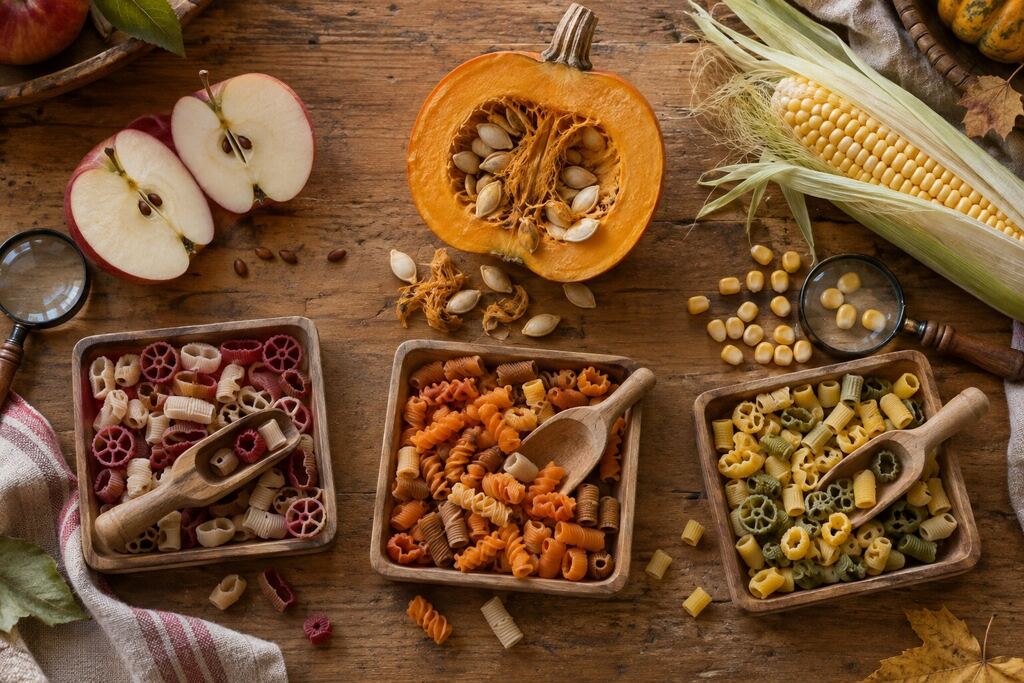
Fall gives us some of the best preschool science materials, and most of them are already waiting at the grocery store.
Apples, pumpkins and corn can be held, opened, pulled apart, sorted, smashed, smelled and compared. Children do not need a complicated experiment or a perfectly finished craft to learn from them. They need real materials, time to investigate and an adult who is willing to wonder alongside them.
These three fall preschool science activities begin with the real thing and then continue into open-ended play. You can use them as individual investigations, spread them across several weeks or bring them together for a simple harvest science study.
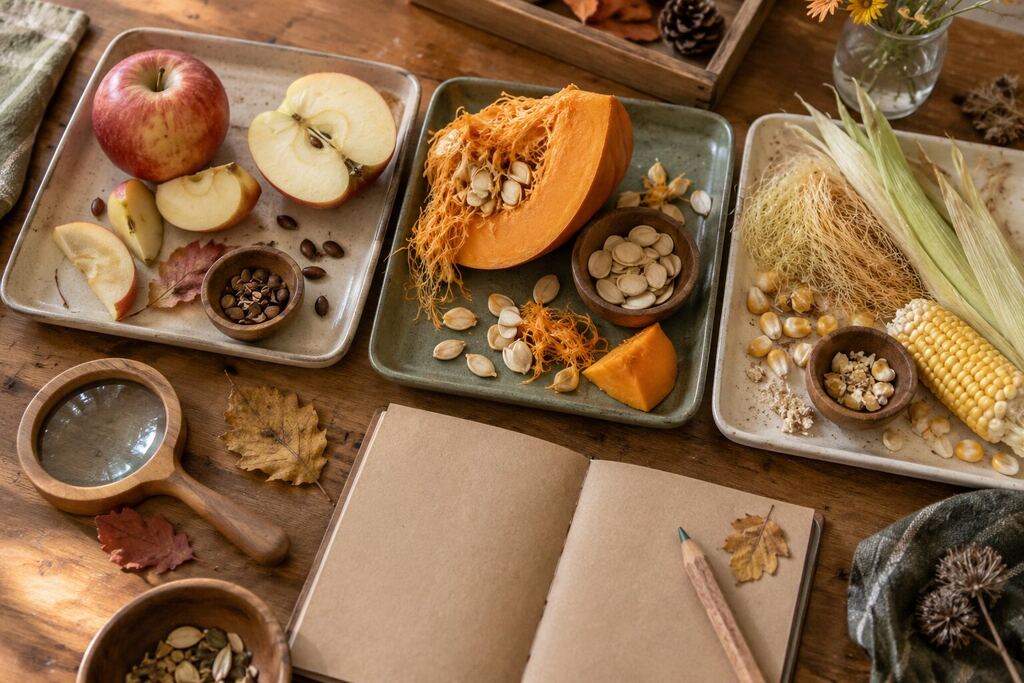
Why Apples, Pumpkins and Corn Work So Well for Preschool Science
Each material gives children something different to notice. Apples change texture when they freeze. Pumpkins hide seeds and tangled fibers behind a smooth rind. Corn has layers—the husk, silk, kernels and cob—that reveal themselves slowly as children pull it apart.
- Observation: What do you notice before and after we open it?
- Comparison: Which parts are hard, soft, smooth, rough, wet or dry?
- Classification: How could we sort the seeds, kernels, pieces or colors?
- Sequencing: How does each plant grow and change?
- Language: Children build real science vocabulary while touching the parts they are naming.
- Creative thinking: Once the investigation ends, loose parts can become something entirely new.
The goal is not to get every child to the same answer. The material provides the spark; the children decide where it goes.
1. Smash Frozen Apples and Make Apple Juice
This is one of my favorite apple activities to do with my class. I freeze whole apples. After they are completely frozen, I take them out and let them thaw just enough to soften. Each child gets a sealed freezer bag with one apple inside, and we use wooden classroom blocks to pound and smash the apple.
Then we open the bags, strain and filter the mashed apple, and taste the juice if our program’s food policies allow it. I do not add sugar. Freezing damages the apple’s cell walls, so the thawed fruit becomes softer and releases its naturally sweet juice more easily.
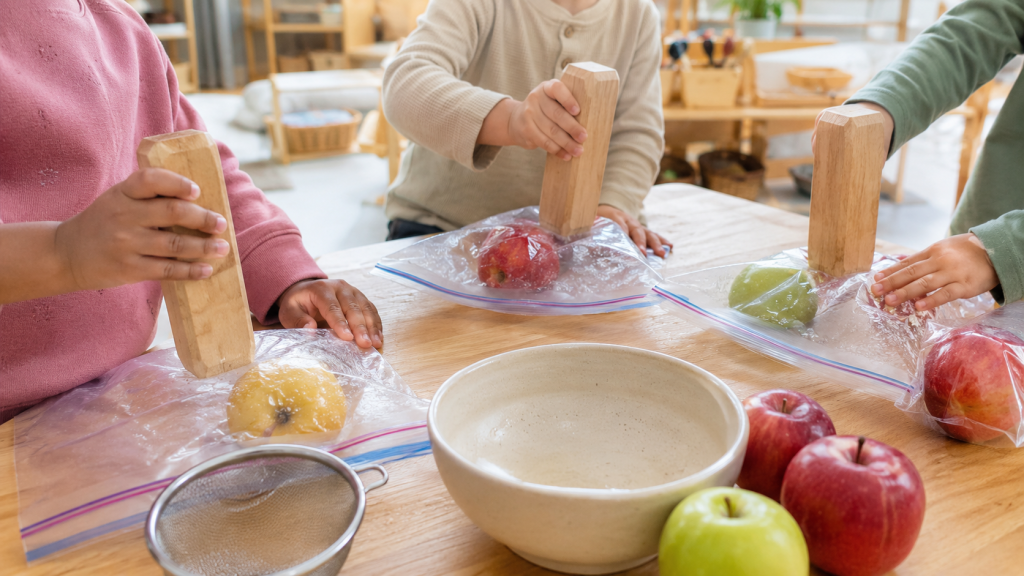
Before explaining the science, ask the children what they notice. Is the apple still hard? What changed while it thawed? Where did the liquid come from? What stayed behind in the strainer?
You can find the complete process, materials list and classroom extensions in Apple Activities for Preschool: Make Apple Juice, Explore Science & Play.
For a ready-to-use science-center follow-up, the Apple Life Cycle & Parts of an Apple Play Beyond Pasta Science Center lets children sequence the life cycle, identify apple parts and build with prepared pasta and loose parts.
2. Cut Open a Pumpkin and Follow the Children’s Ideas
I buy the mini pumpkins from Costco, cut them in half and give each child a half. They dig out the fibers, separate the seeds and decide what they want to do next. That last part matters.
One child may carefully line up every seed. Another may stir the pulp into a container. Someone will probably want to put it all over their arms, while another child wants absolutely nothing to do with it. Those different responses are part of the investigation.
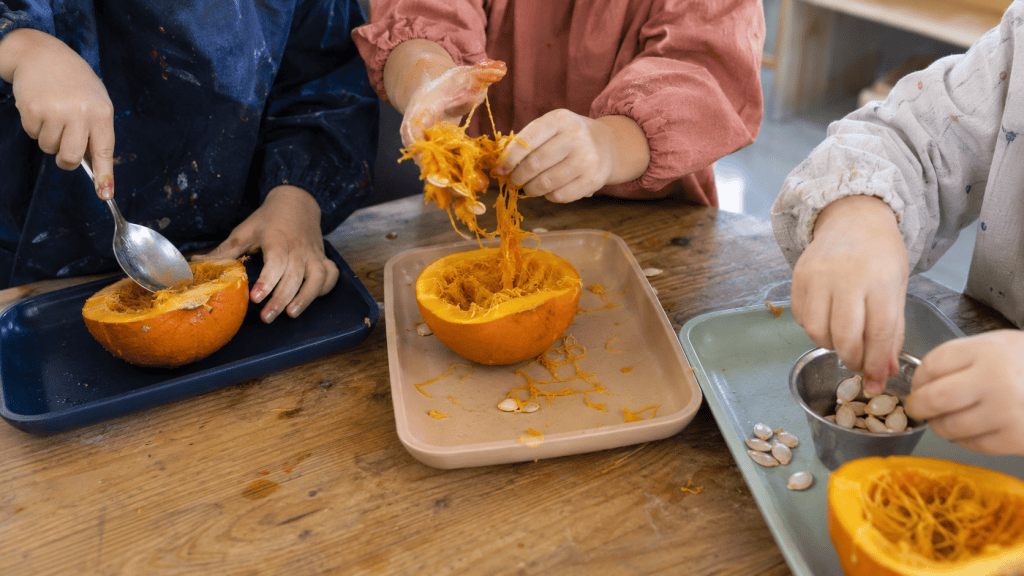
If a child is hesitant, I model that it is okay to be messy. I dig my own hands into the pumpkin, let the fibers hang from my fingers, put some on my arms and tell them it is okay. Most of the time, seeing me genuinely enjoy the mess makes them curious enough to move closer or give it a try. It is still an invitation, never a requirement.
Ask what the children notice before supplying every vocabulary word. Then introduce words such as rind, flesh, pulp, seed and stem as they become useful. The full little experiment is not separate from science; it is how young children begin doing science.
See the full classroom setup in Pumpkin Investigation for Preschool: Cut It Open and Let the Children Lead.
The Pumpkin Life Cycle & Parts of a Pumpkin Play Beyond Pasta Science Center extends that real investigation with vocabulary cards, sorting mats, life-cycle sequencing and open-ended pumpkin-building invitations.
3. Take Apart an Ear of Corn
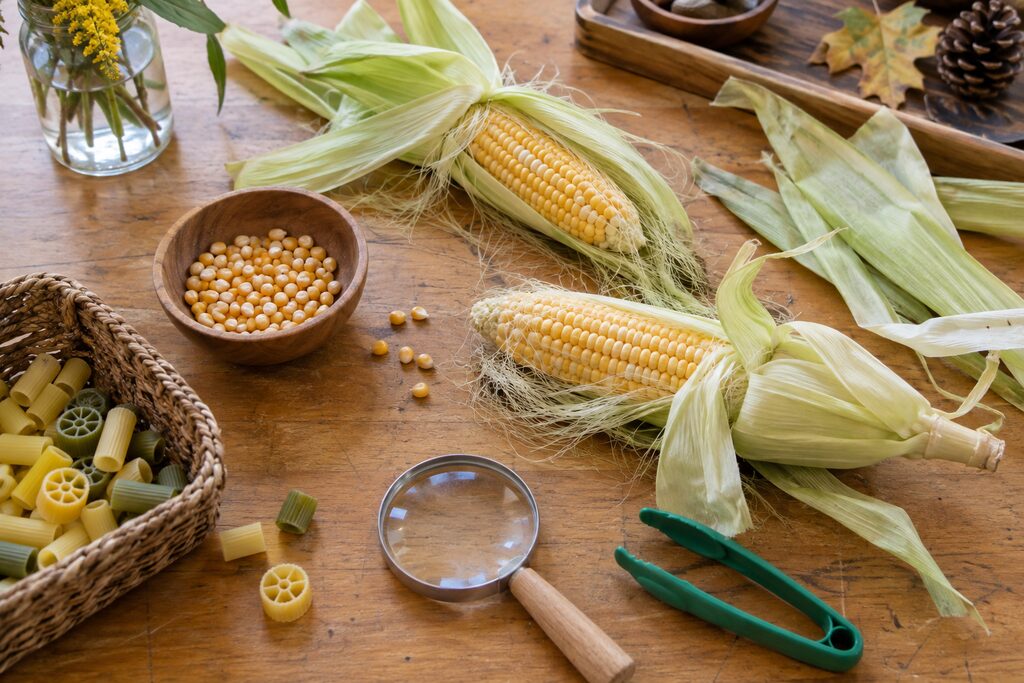
An ear of corn is a science activity before you add anything else. Give children time to pull back the husk, find the silk, feel the kernels and discover the cob underneath. Use fresh corn, dried corn or both so they can compare the textures.
Try placing one whole ear and one partly opened ear on a tray with a magnifying glass and a few small bowls. Let the children decide whether they want to peel, sort, count, transfer or simply look. Supervise closely and follow your program’s food and choking-safety policies, especially with loose kernels.
Questions can stay simple:
- What do you notice first?
- How many layers can you find?
- How does the silk feel?
- What is hiding underneath the kernels?
- How is this like the pumpkin? How is it different?
- What do you think this part does for the plant?
For a printable extension, the Corn Life Cycle & Parts of an Ear of Corn Play Beyond Pasta Science Center includes posters, vocabulary cards, sorting mats and open-ended corn-stalk building mats.
The Real Object Comes First
The printable is not meant to replace the real experience. It gives children a way to return to what they noticed after the apple has been strained, the pumpkin has been cleaned up or the corn has been taken apart.
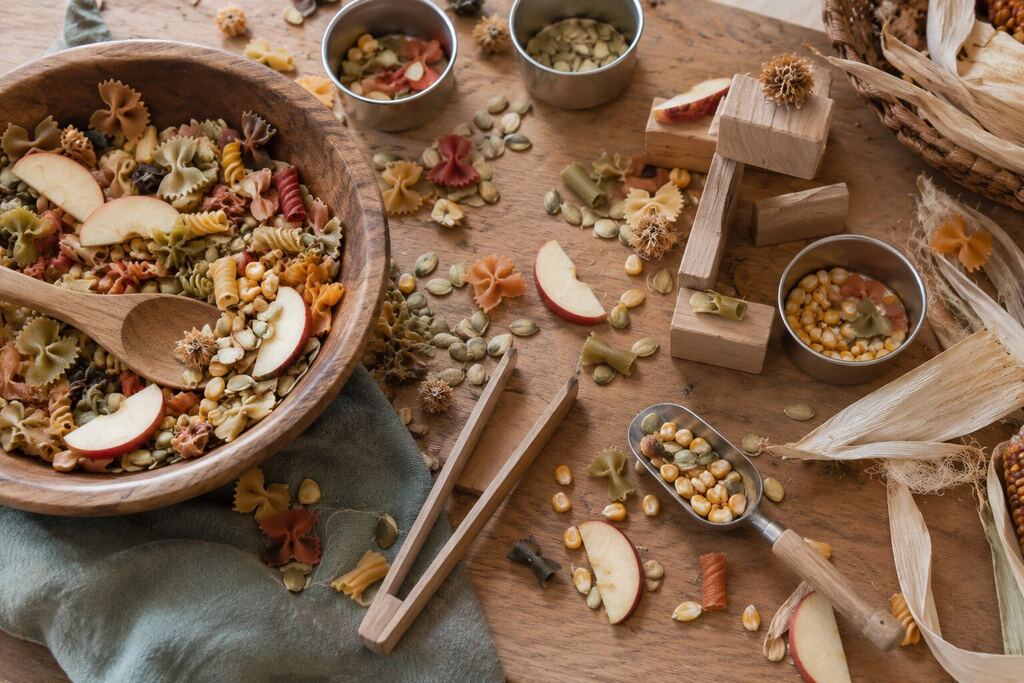
I like to begin with the real material, listen to the children’s questions and then add vocabulary cards, sorting mats, pasta and loose parts. The cards offer information. The pasta offers possibility. A child can sequence a life cycle, match a part, create a pattern or build something that was never pictured on the mat.
That is the idea behind Play Beyond Pasta: the materials are simple, but the thinking does not have to be.
A Simple Three-Day Fall Science Plan
You do not need to squeeze all three investigations into one crowded day.
- Day 1—Apple: Compare fresh and frozen apples, smash the thawed apples and strain the juice. Revisit the experience with apple-parts and life-cycle materials.
- Day 2—Pumpkin: Cut open mini pumpkins, investigate the inside and let each child decide how to explore. Save a few clean seeds for sorting or observation.
- Day 3—Corn: Peel an ear of corn layer by layer, compare the parts and offer loose kernels or pasta for sorting and building where developmentally appropriate.
Keep the materials available longer if the children are still using them. A calendar does not need to end an investigation that still has life in it.
Keep the Questions Open
The fastest way to close an investigation is to decide the answer before the children begin. Instead of asking only questions with one correct response, try:
- What do you notice?
- What changed?
- What could we try?
- How could we sort these?
- What do you think will happen next?
- What do you want to do with it?
That final question is often the most interesting one. Children will give you answers you never planned—and those answers show you what they are thinking.
More Fall Preschool Ideas
For more classroom-tested fall play, see the fall activities I have used in my own preschool classroom.
For new play-based preschool ideas and resources, join the learnplayrepeat email list.
The three science centers are also available together in the Fall Life Cycle Activities Bundle.

