The first monster activity I ever did was not really a “monster theme” at all. We had read The Color Monster, and I wanted the children to have something hands-on to do with all of those feelings and colors.
I gave them colored confetti and paper jars. They sorted the confetti by emotion and glued it into the jars. That was it. My older kids took it a step further by coloring their own Color Monster with the emotion color they chose and writing the feeling beside it.
It was simple, but it worked. The children were talking, sorting, making decisions, and connecting the story to feelings they actually understood. I did not need to turn it into an entire week of perfectly coordinated monster activities.
The monster started as a feeling
I think that is why The Color Monster has always made the most sense to me as a starting point. The monster gives children a way to talk about something that can be hard to explain. Happy, sad, angry, worried, calm—suddenly those feelings have colors and a character attached to them.
The activity can look different depending on the children in front of you. Some may only want to sort and glue. Others are ready to write the emotion word or tell you why they chose it. I would rather let the experience grow that way than decide every child needs to make the exact same monster.
Then the children get to take over
Once you move beyond the book, monsters are basically a blank canvas. There is no real monster for the children to copy. No one can tell them the eyes are in the wrong place or that a monster is not supposed to have seven feet.
That freedom is the part I like. One child may make something silly. Another may make a monster that is tiny and sweet. Someone else may give theirs horns, ten eyes, and a tail that plays music. Their answers tell you much more than a teacher-made example ever could.
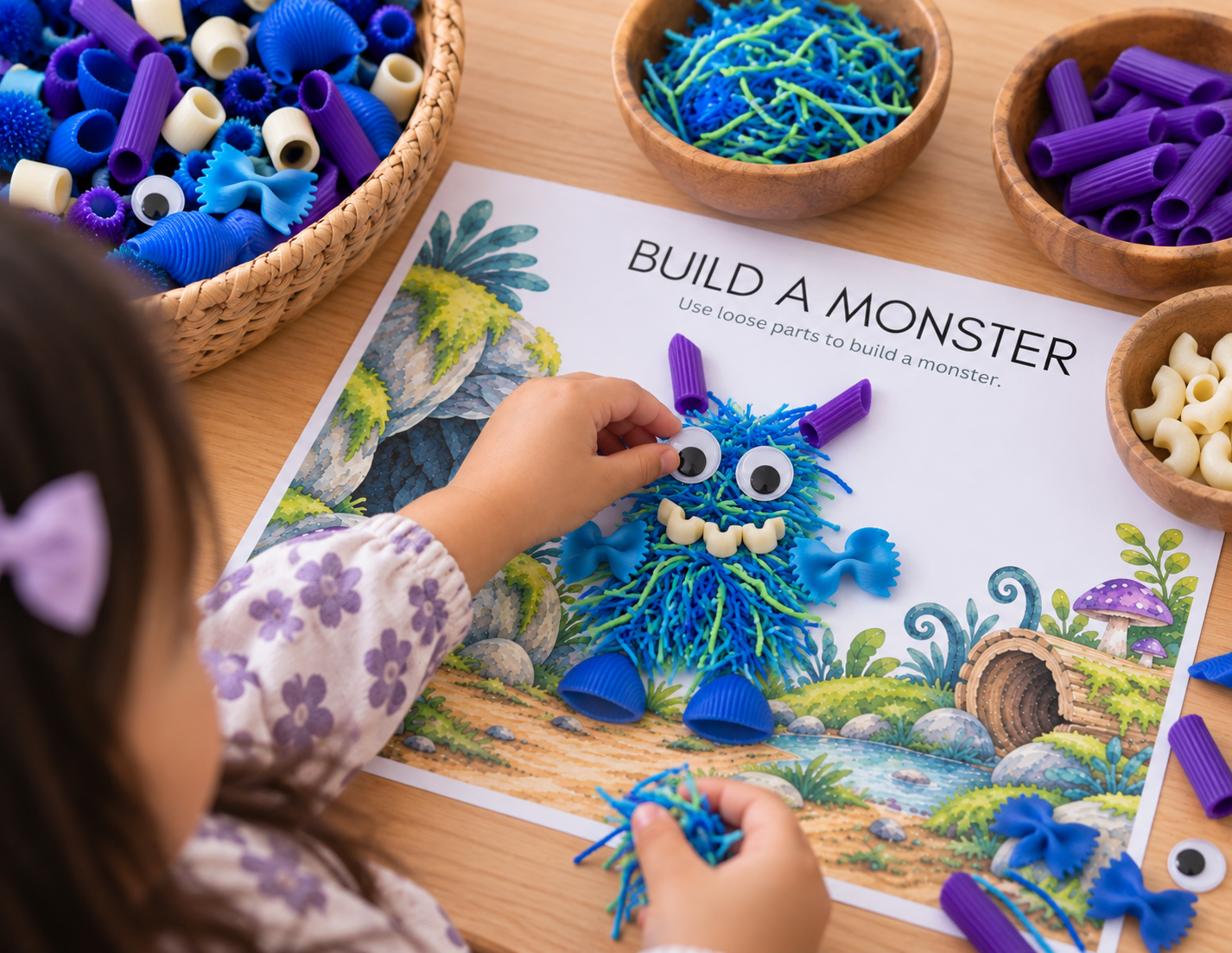
A build-a-monster invitation does not need much. Pasta, pom-poms, googly eyes, pipe cleaners, and a few small loose parts are enough. Some children will use a picture as a guide. Others will ignore the guide completely and invent their own parts. I am fine with both.
The seed provides the spark; the children decide where it goes.
What does a monster even need?
This is where a monster theme becomes much more interesting than a cute craft. A child has to decide what their monster looks like, how it moves, and what each part does.
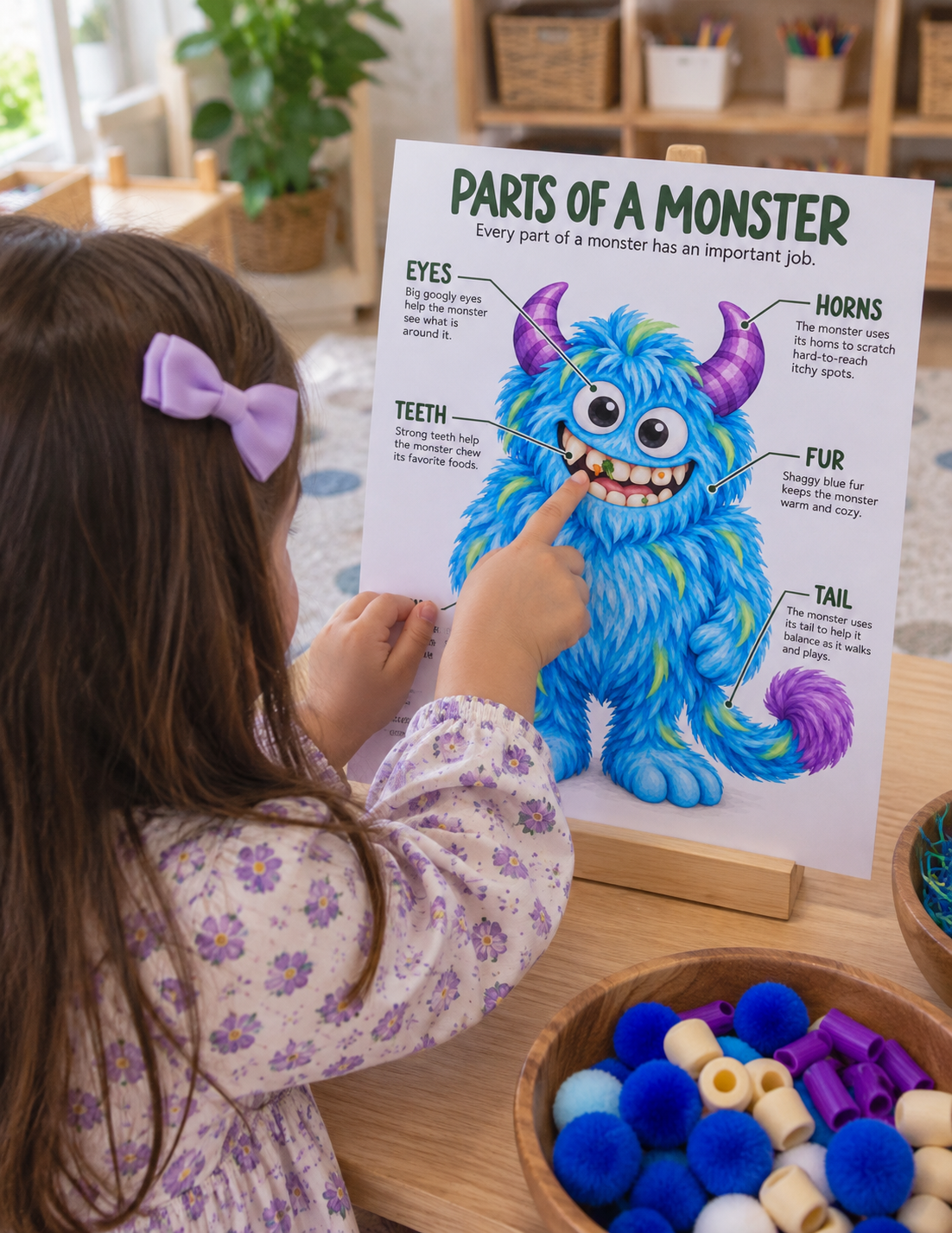
You might hear that the horns help it listen, the tail is really an extra arm, or the fur changes color when it is hungry. I would ask questions, but I would not give the answers. “Tell me about this part” will usually get you much farther than “What is this?”
You can also ask what the monster needs. Maybe it needs candy. Maybe it needs music, play, or love. That question shifts the conversation away from what a monster has and toward who the children imagine it to be.
Yes, the monster life cycle is pretend
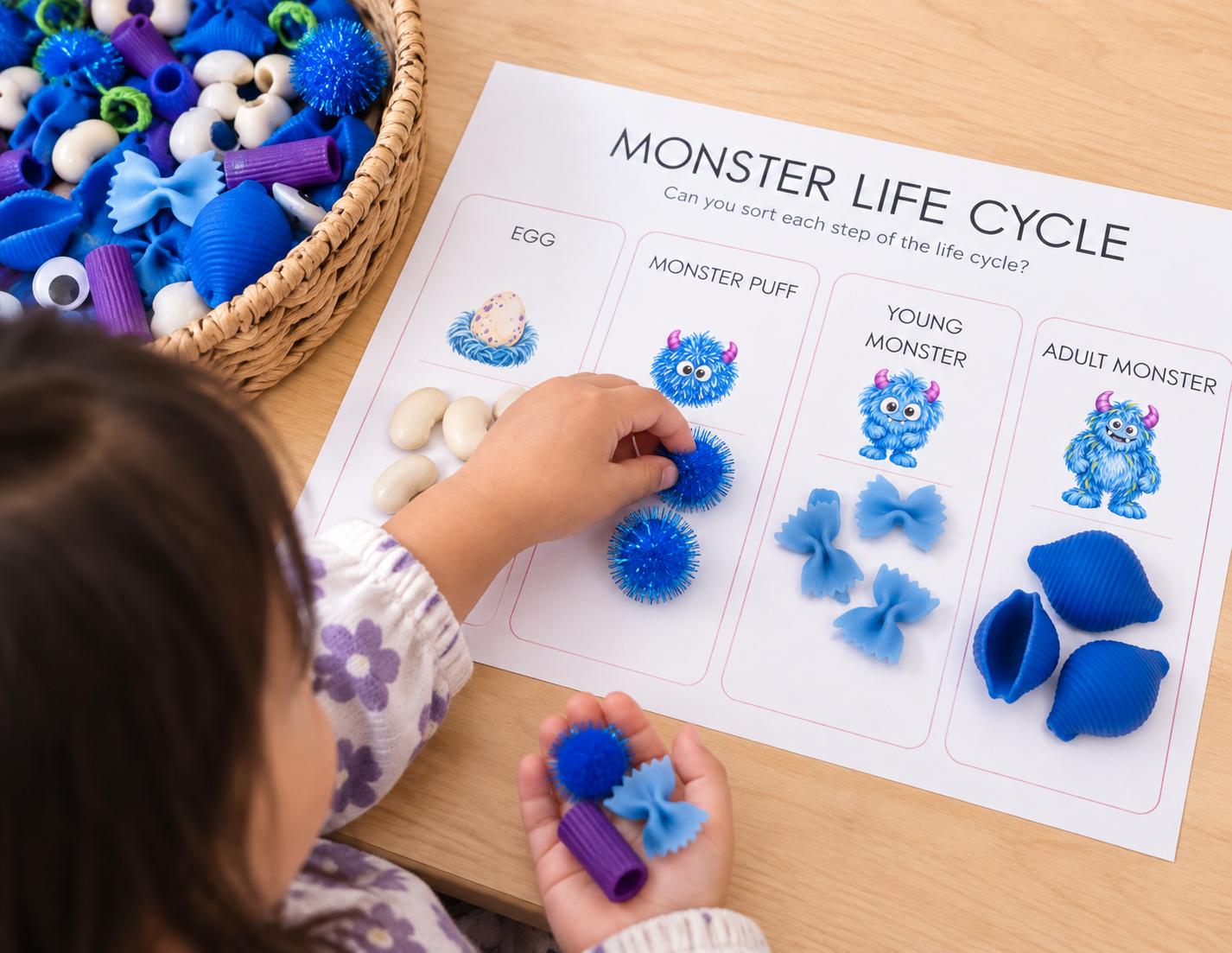
There is obviously no factual monster life cycle. The sequence—monster egg, monster puff, young monster, and adult monster—is completely fictional. I would tell the children that plainly. We are making up what could happen to an imaginary creature.
That does not make the activity useless. It gives children a playful reason to put events in order, use words such as first, next, and last, and explain what they think happens between the stages. The learning is in the sequencing and the story they build around it—not in pretending monsters are real animals.
Let the sensory bin become whatever they need
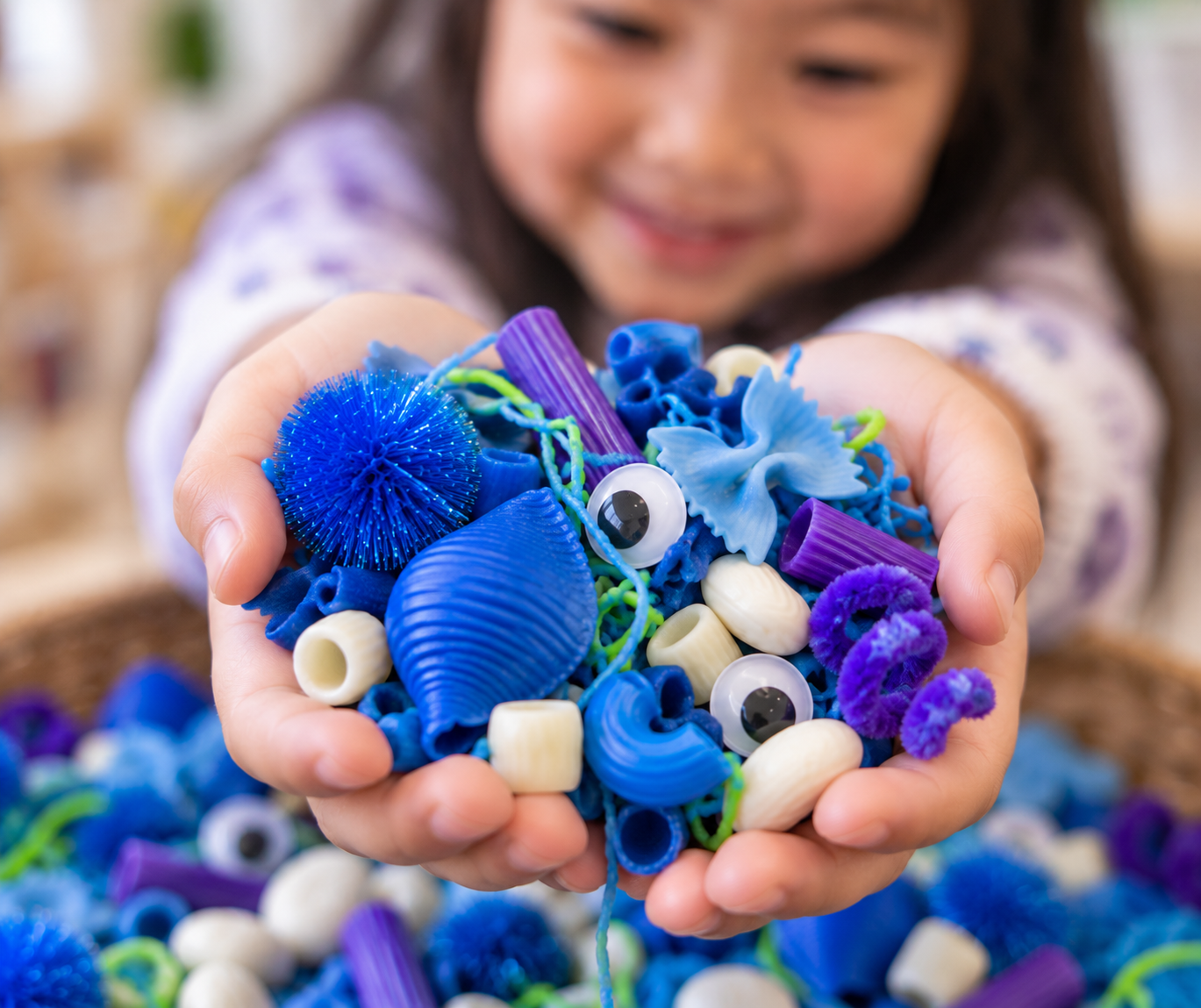
The same materials can move into a sensory bin without adding a complicated set of directions. Children might scoop and pour the pasta, hunt for monster parts, sort pieces onto mats, or carry everything to another area and start building.
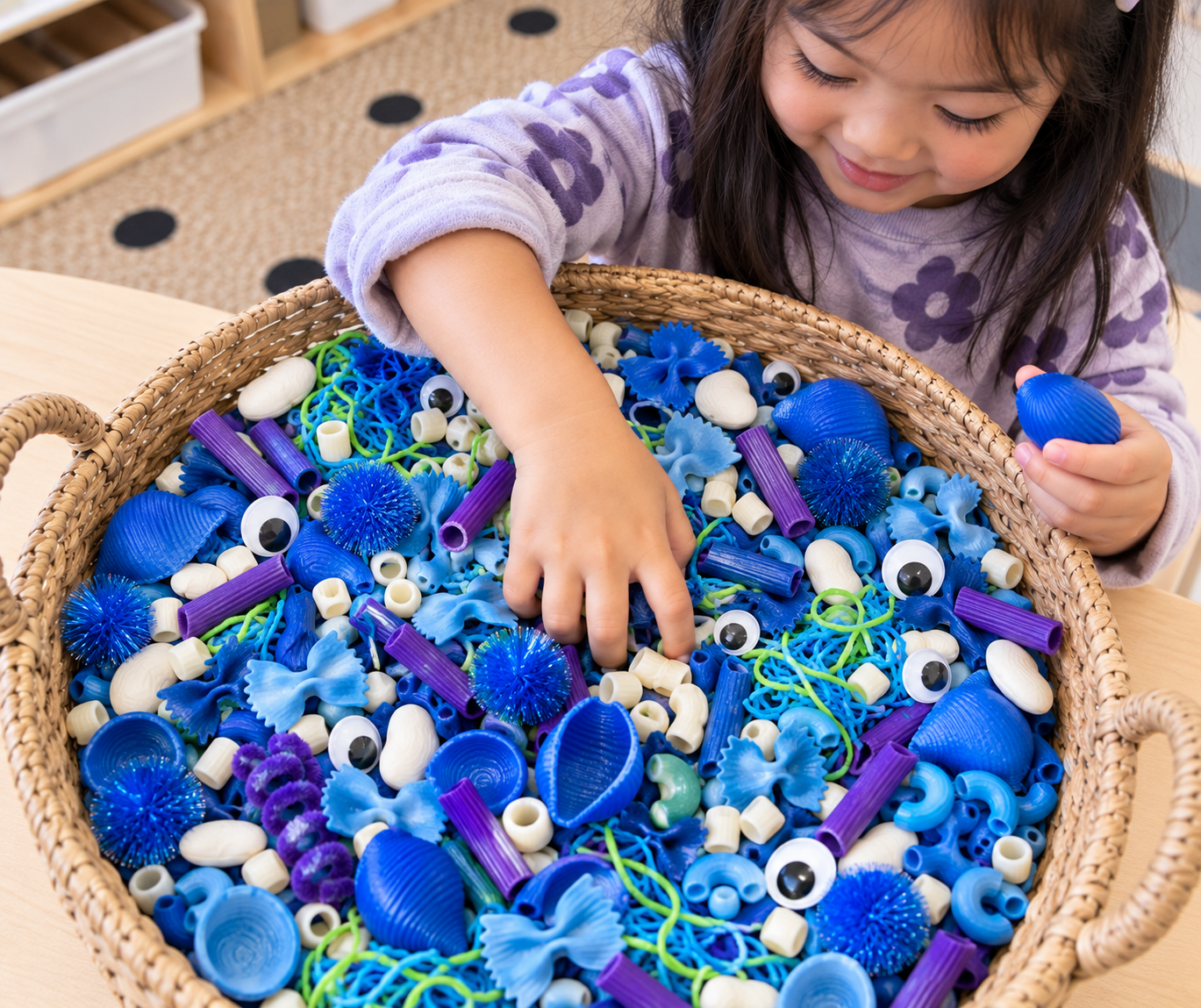
I do not think every child needs to reach the same “finished” activity. If one child spends the entire time running pasta through their fingers and another carefully builds a monster, they both found a way into the materials.
If a child says the monster is scary
I see monsters as silly, but children are allowed to see them differently. If a child tells me a monster is scary, I ask what feels scary and listen to the answer. I also remind them that monsters are not real.
I am not going to force a child to touch the materials or make a monster. They can watch, choose a friendlier-looking part, or decide they are not interested. At the same time, I do not want to build the monster up into something more frightening than it needs to be. Sometimes a calm reminder and a very ridiculous pair of googly eyes are enough.
Want the monster pieces ready for you?
I put the fictional life cycle, monster-parts cards, posters, sorting mats, and Build a Monster mats together in the Play Beyond Pasta Monster Unit. You can use the pieces as a starting point and still leave the actual monster—and the story behind it—up to the children.
A monster theme does not need to become a pile of matching crafts. Start with a book, a feeling, or a handful of loose parts. Then see what the children do with it.

