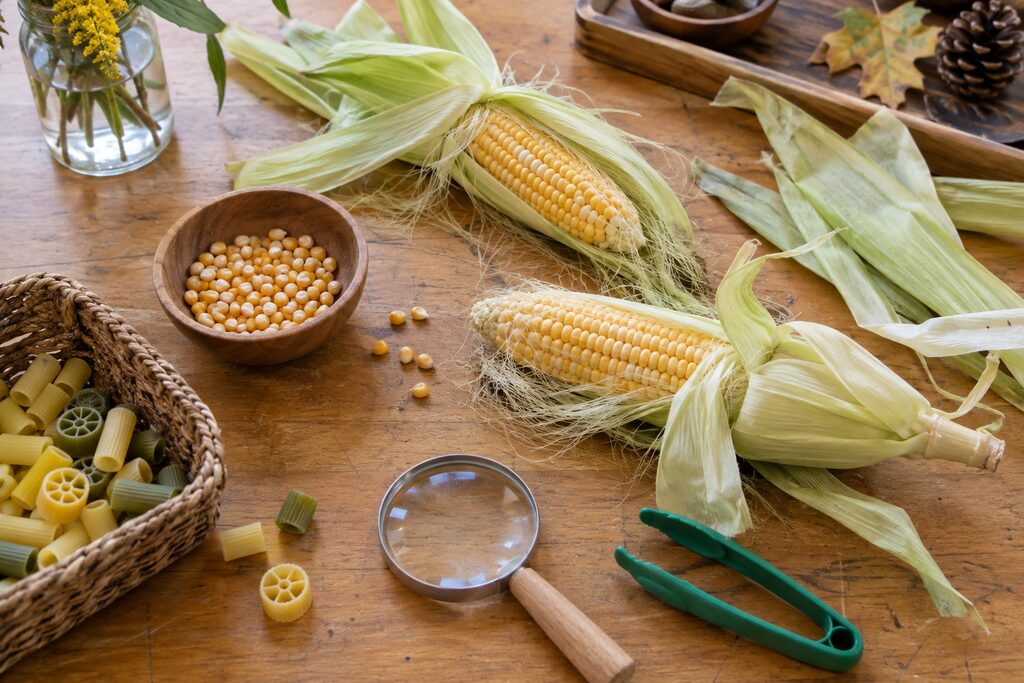
There is something about handing preschoolers a real ear of corn that makes the whole room slow down and look closer. The husk has layers. The silk clings to everything. The kernels make patterns children can see and feel. One simple fall material can become a sensory experience, a science investigation, and an invitation to create.
This corn activity is intentionally open-ended. I begin with a real ear of corn and a few useful tools, then let the children’s questions and ideas shape what happens next.
What you need
- Fresh ears of corn with the husks still attached
- A tray or shallow bin for each small group
- Magnifying glasses
- Bowls or baskets for husks, silk, kernels, and cobs
- Child-safe tweezers or tongs, if you want to add a fine-motor tool
- Optional: yellow, green, and tan pasta or other loose parts for building
Choose corn that children can safely handle and supervise closely. Follow your program’s food and allergy policies, especially if children will remove or taste kernels.
Start by noticing
Place the whole ear of corn on the table before explaining anything. Give children time to look, touch, smell, and wonder. Their first observations are often better conversation starters than a long introduction.
You might ask:
- What do you notice?
- What do you think is inside?
- How does the husk feel?
- What are these tiny threads?
- Why do you think the kernels grow in rows?
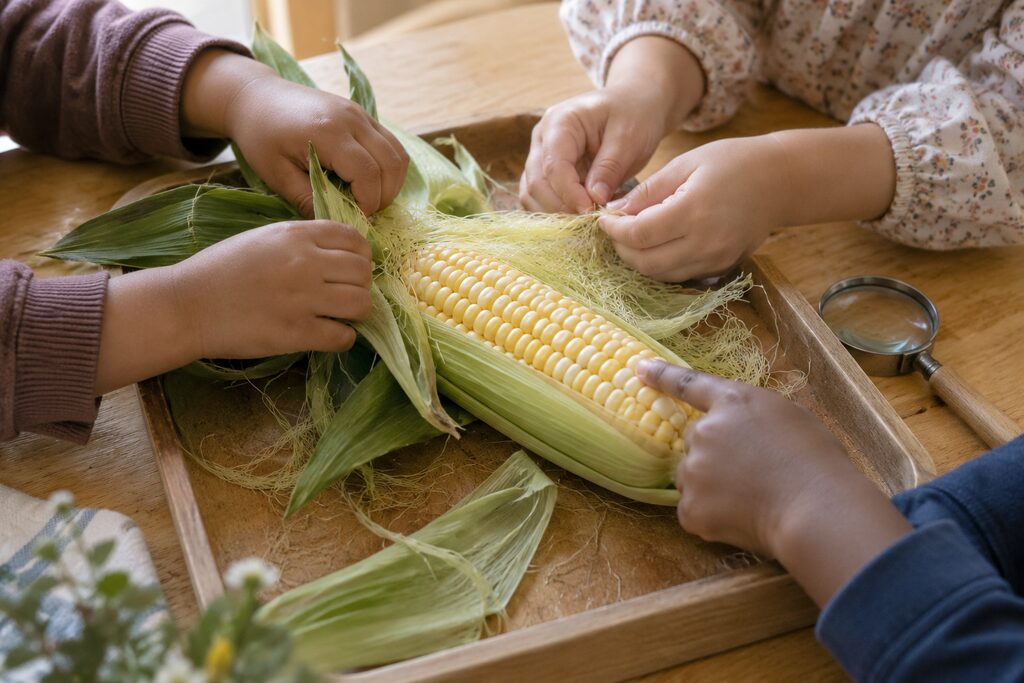
Let children husk and investigate the corn
Invite children to pull back the husk one layer at a time. They can separate the silk, compare the inside and outside of the husk, count rows, look for different kernel shapes, and examine the cob after kernels have been removed.
I do not expect every child to interact with it in the same way. One child may want to pull off every strand of silk. Another may only watch. A child who does not want to touch the corn can use tongs, hold the magnifying glass, make observations, or join when they feel ready. Participation can look different and still be meaningful.
Sort what you find
Once the corn is open, set out a few bowls and let children decide how to organize the pieces. They may sort by part—husk, silk, kernel, and cob—or invent their own categories by color, texture, size, or purpose. Ask them to explain their thinking instead of correcting the system they create.
Build beyond the investigation
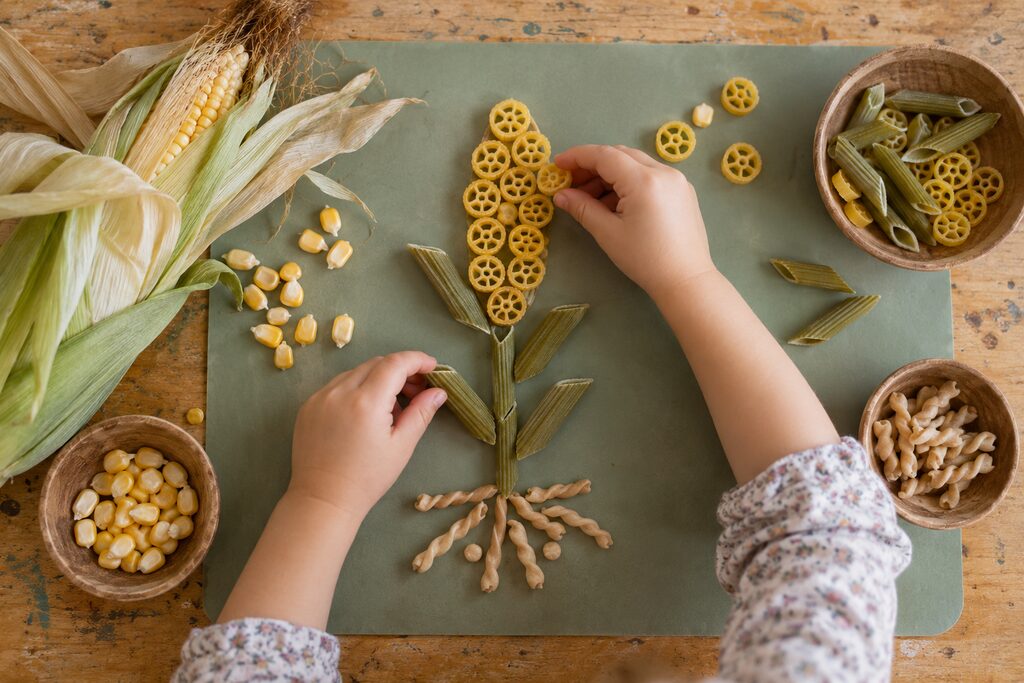
After children have explored the real corn, add pasta or another familiar loose part. Some children may rebuild an ear of corn. Others may make a tall stalk, roots underground, a garden, a machine, or something that has nothing to do with corn at all. That is the point: the seed provides the spark; the children decide where it goes.
What children are learning
- Science: plant parts, life cycles, texture, change, and observation
- Language: husk, silk, kernel, cob, stalk, seed, sprout, rough, smooth, and sticky
- Math: sorting, classifying, comparing, estimating, and noticing patterns
- Fine-motor skills: pulling, pinching, transferring, and arranging
- Creative thinking: planning, revising, representing ideas, and using materials in new ways
Want the printable science pieces ready to go?
My Corn Life Cycle & Parts of an Ear of Corn Play Beyond Pasta Science Center includes the life cycle and parts posters, vocabulary cards, sorting mats, two open-ended corn-stalk building mats, and a pasta guide. Use as much or as little as supports the play already happening in your classroom.
If you want more play-based preschool ideas, new-resource updates, and simple invitations you can actually use, join the learnplayrepeat email list.

