I remember planning a craft for a group of 12 children who were around two-and-a-half to three years old.
I don’t remember exactly what we were making, but I remember that I had a very specific result in mind. I wanted the children to cut their own pieces and glue them onto the page.
In my head, it seemed simple enough.
Except some of these children had never even seen a glue stick or held a pair of scissors before.
Instead of recognizing that they were still learning how to use the materials, I became frustrated.
“No, that’s not how you use the glue.”
“No, we don’t hold scissors like that.”
I was trying to help 12 very young children cut, glue, follow directions, and create the result I had already imagined. I became so overwhelmed that I finally gave up and threw the whole activity away.
But the frustration did not disappear when the craft did.
I carried it with me for the rest of the day.
The children had not done anything wrong. I had expected them to use two unfamiliar tools, follow several directions, and make a specific product—all at the same time.
I was focused on the activity I had planned instead of the children standing in front of me.
I think we can easily do the same thing during the first week of preschool.
We are excited. The classroom is ready. The curriculum is planned. We want to begin.
But the children may not be ready for everything we have planned yet.
Before we teach the curriculum, there are other things they need to learn first.
They Need to Learn That We Are Safe
When children enter our classroom, they do not know us yet.
They do not know if we will help them when they are upset. They do not know if we will listen when they say no. They do not know how we will respond when they make a mistake.
A child who does not follow a direction during the first week may not be defiant. They may be unsure, overwhelmed, or afraid.
Relationships have to come before compliance.
We can greet children by name, get down to their level, sit beside them while they play, and notice what they are interested in. We do not have to immediately question them or direct their play.
Sometimes they just need us to be there.
We can say:
- “I’m glad you’re here.”
- “You can stay close to me while you look around.”
- “You can watch until you’re ready.”
- “I’ll help you.”
These moments may not be written into the curriculum, but they are what allow the curriculum to happen later.
They Need to Learn What Will Happen
Adults understand how a classroom day works.
We know that cleaning up does not mean the toys are gone forever. We know that snack comes after outside time. We know that every grown-up will return at the end of the day.
The children may not know any of that.
Even children who have been in preschool before have not been in this classroom. They still need to learn how our room works.
We do not need to explain the entire schedule at once. We can explain each part of the day as it happens.
“First we put the blocks away. Then we choose a book.”
“When you hear this song, it is time to clean up.”
“Your mommy or daddy will come back after our classroom day.”
We may have to repeat ourselves many times.
That does not mean the children are not listening. It means they are learning.
They Need to Learn How to Use the Classroom
When I think back to that craft, I realize I was trying to teach too many things at once.
I wanted the children to learn how to hold scissors, how to cut, how to use glue, where to place the pieces, and how to complete the project I had planned.
Now I separate those skills.
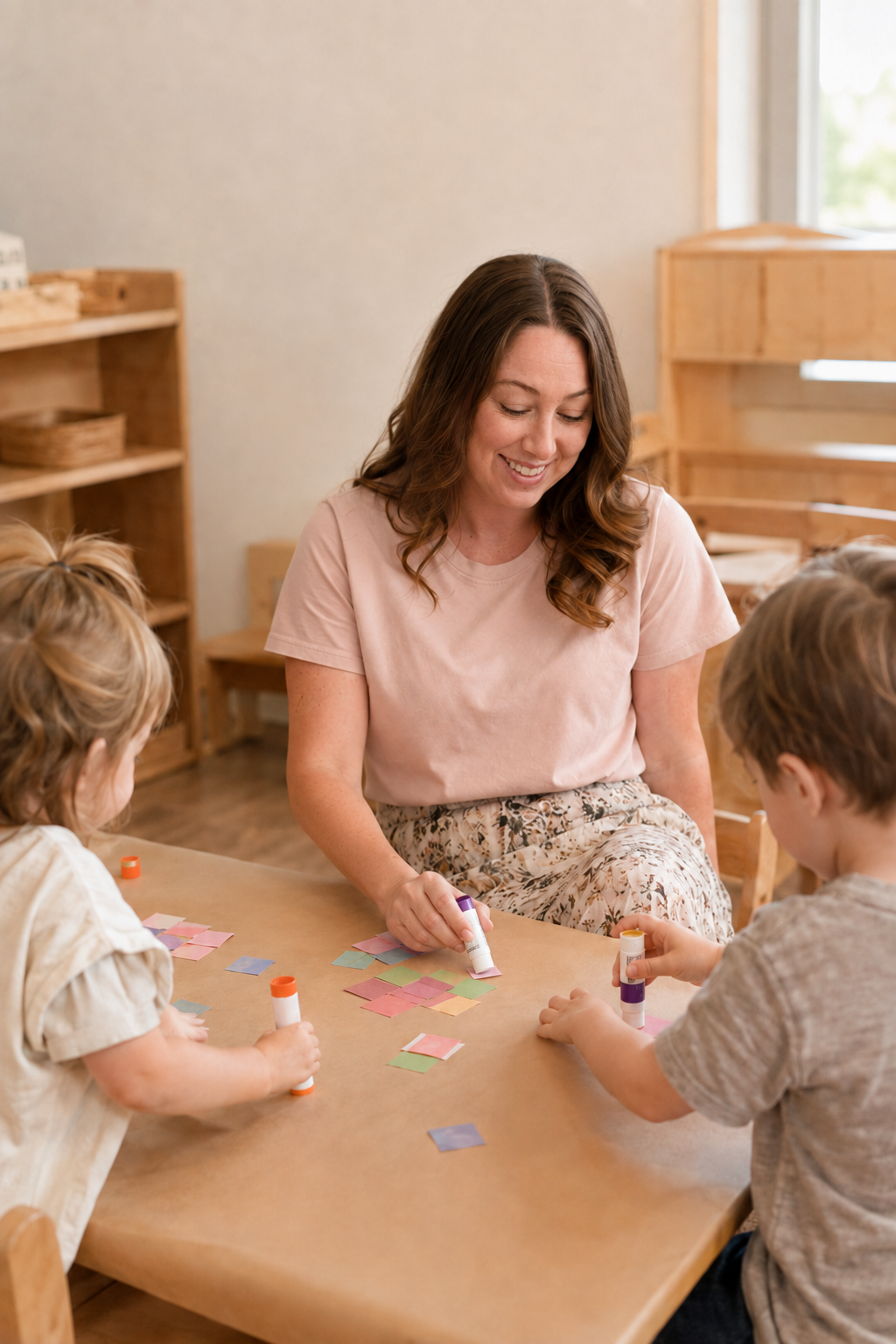
If children are learning how to use glue, I might put a large piece of butcher paper on the table, provide glue sticks and precut squares, and let them glue the pieces wherever they want.
The goal is not to create a particular craft.
The goal is to explore the glue.
They can learn how much pressure to use, how to twist the glue up and down, and how to make something stick. Once they understand that material, we can build on the skill later.
The same idea applies throughout the classroom.
The way the room is arranged can make this easier for children, too. You can see how I set up my preschool classroom here.
We can show children that playdough stays on the table without showing them exactly what they must create. In dramatic play, one child may use the kitchen to prepare dinner, while another turns it into a restaurant, bakery, or grocery store.
We provide the boundaries. The children decide where the play goes.
This shift is also what led me to think more deeply about why open-ended play matters.
They Need to Learn That Big Feelings Are Allowed
The first week can be overwhelming.
There are new adults, new children, unfamiliar noises, different routines, and separation from the people children trust most.
Big feelings are not interruptions to the first week.
They are part of the first week.
A crying child does not need to be hurried into feeling happy. A child who is not ready to join the group does not need to be forced into participating.
We can say:
- “I know—you miss your mommy or daddy. I’m right here with you.”
- “I know—it’s frustrating when a friend is using the toy you want. We can set a timer.”
- “You don’t have to join yet. You can watch from here.”
- “Your body looks upset. Let’s take some deep breaths.”
Supporting a child’s feelings does not mean allowing unsafe behavior.
We can say, “I won’t let you hit. You are angry, and I’m going to help you keep everyone safe.”
Children need to experience us staying calm, holding the boundary, and helping them through the hard moment.
They cannot learn that from one conversation at circle time.
I share more practical examples in Simple Strategies for Teaching Preschool Behavior.
The Activities Can Be Simple
I used to think a successful activity was one that ended with the result I had planned.
Now I pay more attention to what the children are actually learning.
During the first week, simple activities give children room to explore and give us room to observe.
We can offer blocks, open-ended art, sensory materials, dramatic play, familiar songs, movement, and uncomplicated stories.
Then we can watch.
Who begins playing right away?
Who needs time to observe?
Who asks for help?
Who becomes overwhelmed during transitions?
Which materials hold their attention?
How do they respond when another child joins their play?
These observations tell us what the children need next.
A completed craft cannot always tell us that.
Looking for More Open-Ended Ideas? If you want practical ways to give children more freedom to explore without having to invent every activity yourself, take a look at my Play Beyond Purpose preschool resources.
The Curriculum Can Wait
I am not saying that children are not learning during the first week.
I am saying that the learning may not look like the lesson plan.
They are learning whether we listen to them.
They are learning how to enter a group, care for materials, communicate what they need, and recover from a difficult moment.
They are learning that another child can have a different idea.
They are learning that they can make a mistake and try again.
They are learning whether this classroom is a place where they feel safe enough to be curious.
If we do not complete every activity we planned, we are not behind.
If the children are beginning to recognize the routines, approach us for help, explore the classroom, and trust that their grown-ups will return, meaningful learning has already begun.
Before we teach the curriculum, we have to teach children that the classroom is safe.
That their ideas matter.
That mistakes can be repaired.
That we will help them learn what comes next.
That is not time taken away from the curriculum.
It is what makes the curriculum possible.
Want More Honest, Practical Preschool Ideas?


One thought on “The First Week of Preschool: What to Teach Before You Teach the Curriculum”