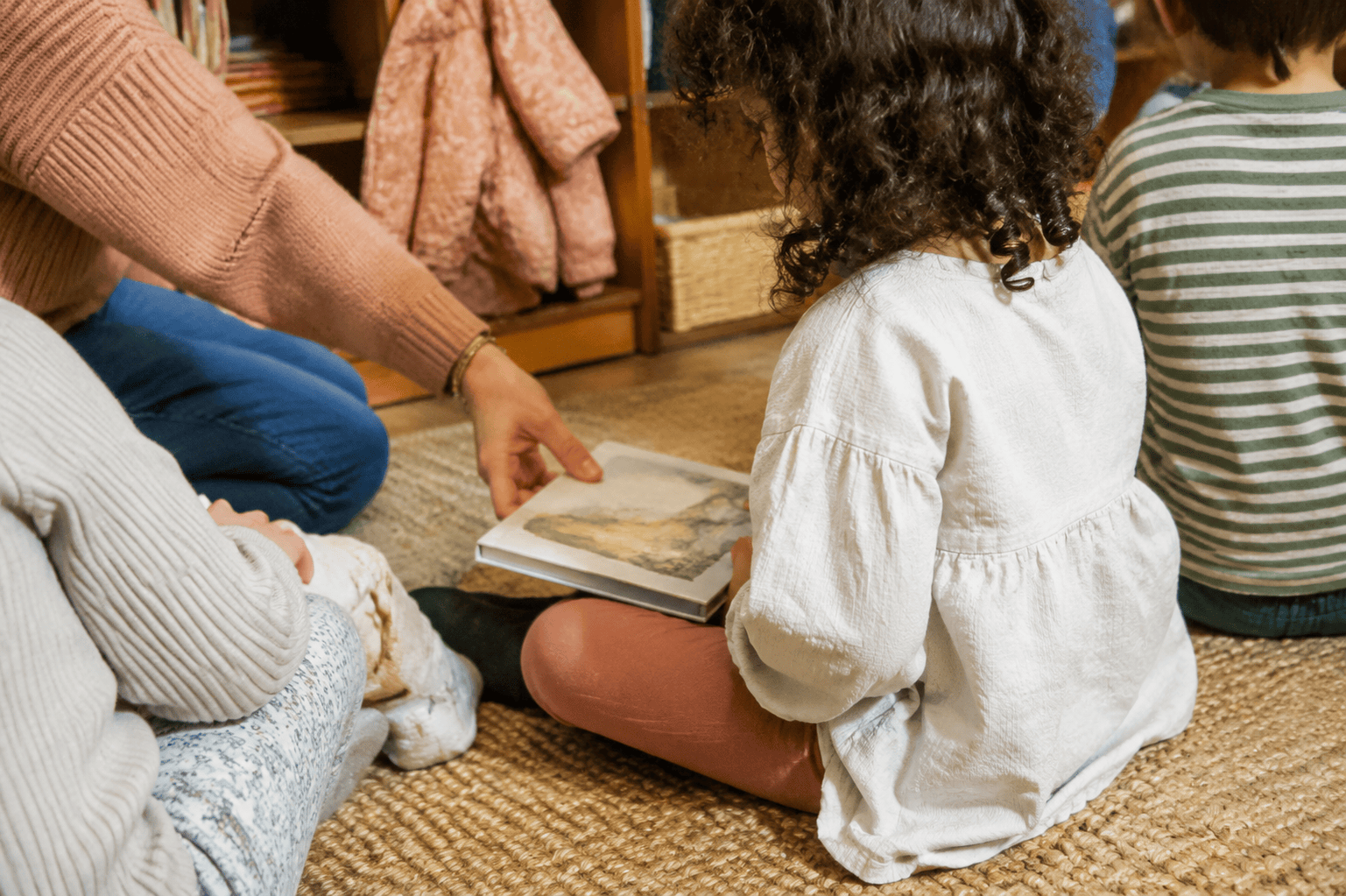
There are days in preschool when it feels like I have said the same direction 47 times before 9:30.
Put the book away. Find a spot. Put on your jacket. Bring your body back to the group. Try again.
I used to think a successful classroom routine meant that I had explained everything clearly enough and the children followed the plan. The longer I have taught, the more I have realized that routines are not perfect little scripts. They are familiar patterns children can eventually carry for themselves.
And sometimes the best routine is not a picture chart, a song I found online, or a complicated behavior system.
Sometimes it is three silly words.
Sometimes it is a sound effect.
Sometimes it is getting quieter when the whole room gets louder.
These are the preschool classroom routines and cues that have actually stayed with my children—not because they are fancy, but because they are short, memorable, and built for the way young children learn.
1. Turn a Direction Into a Rhythm
One of my favorite tricks is to put a direction into a simple three-beat rhythm:
“Put the book in your lap, lap, lap.”
“Sit down on your bottom, bottom, bottom.”
The children quickly learn the repeated ending. After they have heard it a few times, I can begin the direction and let them finish it.
That small change matters. They are no longer just listening to me give another command. They are participating in the cue—and often completing the action before I finish talking.
You do not need a special song for every part of the day. Take a direction you repeat constantly and give the last word a steady beat:
- “Put it in the bin, bin, bin.”
- “Meet me by the door, door, door.”
- “Find a spot upon the rug, rug, rug.”
Keep the words simple and use the same rhythm each time. The goal is not to perform. The goal is to give the children a pattern they can recognize and eventually use without you.
2. Give the Movement Its Own Sound
Some movements make more sense to children when they have a sound.
When we form the letter S, we might make a “shoop woop” sound as our hands move through the curve. When a jacket sleeve is stuck inside out, we pull it back through with a big “high-ya!”
I use sound effects for writing, cutting, gluing, putting on clothing, and moving our bodies. The children repeat the sound—and the sound helps them remember what the movement is supposed to do.
This works especially well for directions that are hard to explain with words alone. Instead of adding a longer explanation, I pair one short sound with the physical action and model it.
Then I let them try.
That last part is important. Independence is not doing everything perfectly the first time. It is being given enough time and space to attempt the next step.
3. When the Room Gets Loud, Try Getting Quieter
When my classroom becomes overwhelmingly loud, I do not try to beat the noise.
I whisper.
I make my facial expressions very big and begin talking so quietly that the children have to lean into the moment to figure out what is happening. Their attention is almost instantly drawn toward me.
It works because it is unexpected. If I raise my voice, I become one more loud sound in a room already full of them. A whisper changes the pattern.
This is not a magic trick that fixes every loud moment, and I am not whispering to demand silent compliance. I am giving the group a new point of focus so we can reconnect.
The dramatic face helps too. Preschoolers read so much through expression and movement. When my face says, You are going to want to hear this, their curiosity often does the work that volume cannot.
4. Keep Circle Time Short Enough to Stay Joyful
I once panicked before leading a mid-day circle time at a Montessori school. A director told me that eventually I would be able to walk into a closet, pull out almost any object, and run a circle time with it.
At the time, I could not imagine that ever feeling natural.
But I learned by watching the children. I tried ideas. I changed them. I noticed what held their attention and what absolutely did not. Eventually, I stopped measuring a successful circle time by how much of my plan I completed.
Seven good minutes will always beat 20 minutes of managing children who are done.
A dependable preschool circle time routine can be very simple:
- Welcome the children or say their names.
- Sing or move together.
- Practice one small language or listening skill.
- Explore one tiny concept.
- Read a book.
- Use the same closing cue to move into what comes next.
Some children will answer. Some will imitate. Some will watch quietly. Some may step away and rejoin. Participation does not have to look identical for every child.
The familiar shape of the routine gives children security. The flexibility inside it allows them to remain children.
5. Teach the Routine During the Real Moment
Preschoolers do not learn a classroom routine because we posted it on the wall once.
They learn it while standing at the sink with wet hands. While trying to zip a coat. While waiting for the same red cup. While figuring out where the marker belongs. While recovering after something did not go their way.
Those moments are not interruptions to the curriculum. They are the curriculum.
I can model the first step, reduce the number of words I use, and allow the child to do the next part. If it does not work, we try again. If the routine is too complicated for the children to carry, I change the routine.
A visual can help, especially for a routine with several steps. But the picture is a reminder—not the teaching itself. The teaching happens beside the child in the actual moment.
6. Let the Children Tell You When the Plan Needs to Change
Consistency is helpful. Rigidity is not.
If my plan says circle time should last 15 minutes and the children show me they have seven good minutes today, I have a choice. I can cling to the schedule and spend the final eight minutes correcting bodies—or I can notice what is happening and move on.
The same is true for every classroom routine. A routine should support the children in front of me. The children should not have to serve the routine.
Sometimes a group needs more movement between activities. Sometimes a child needs one direction instead of three. Sometimes the cleanup routine has too many steps. Sometimes my beautiful plan simply does not work.
Changing it does not mean I failed to be consistent. It means I was paying attention.
What Preschool Independence Really Looks Like
Independence is bigger than putting on a coat or cleaning up without help.
It can look like:
- entering a group even when it feels uncertain
- asking for help
- remembering one part of a familiar routine
- waiting through frustration
- trying a movement again
- recovering when something goes wrong
- knowing that a trusted adult believes you are capable
These skills are built in tiny repetitions throughout the day. That is why the simplest preschool classroom routines can matter so much.
Three Cues to Try Tomorrow
If your day feels like one endless stream of reminders, do not rebuild your entire schedule tonight. Choose one moment.
Try:
- adding a three-beat ending to the direction you repeat most
- pairing a tricky physical action with one memorable sound
- whispering with an exaggerated expression instead of talking over the noise
Use it consistently for several days. Watch what the children do. Keep the parts that help them, and change the parts that do not.
That is the routine.
Not perfection. Not control. A familiar path the children can gradually learn to walk for themselves.
These Are the Stories Behind My Book
These small classroom moments—when a rhythm works better than another reminder, or when we change the plan because the children show us what they need—are at the heart of the preschool teacher book I’m writing, It’s Not Your Day… It’s Theirs.
It is an honest, story-led look at learning to teach with children instead of trying to control every part of their day.
If that sounds like the kind of teaching conversation you have been looking for, join the early-access list for behind-the-scenes updates and the release announcement.
Helpful Resources
Bathroom routines can be especially difficult because school and home need to feel predictable together. The Potty Training Toolkit for Preschool includes bathroom visual schedules, forms, a social story, and practical independence supports.
Teaching younger children and wondering why the day feels so different? Read Teaching Two Year Olds: The Honest Truth No One Tells First-Year Toddler Teachers.
Want more honest, play-based preschool ideas and practical resources? Join the Learn Play Repeat email list.

